


Paper published in Chemical Engineering Journal
Collaborative study with Seoul National University on a molten GaBi catalyst for low-carbon hydrogen via moderate-temperature methane pyrolysis, published in Chemical Engineering Journal.
Our collaborative research with Prof. Sangwook Park’s and Prof. Jeong Woo Han’s groups at Seoul National University on a molten metal catalyst for clean hydrogen production has been published in Chemical Engineering Journal.
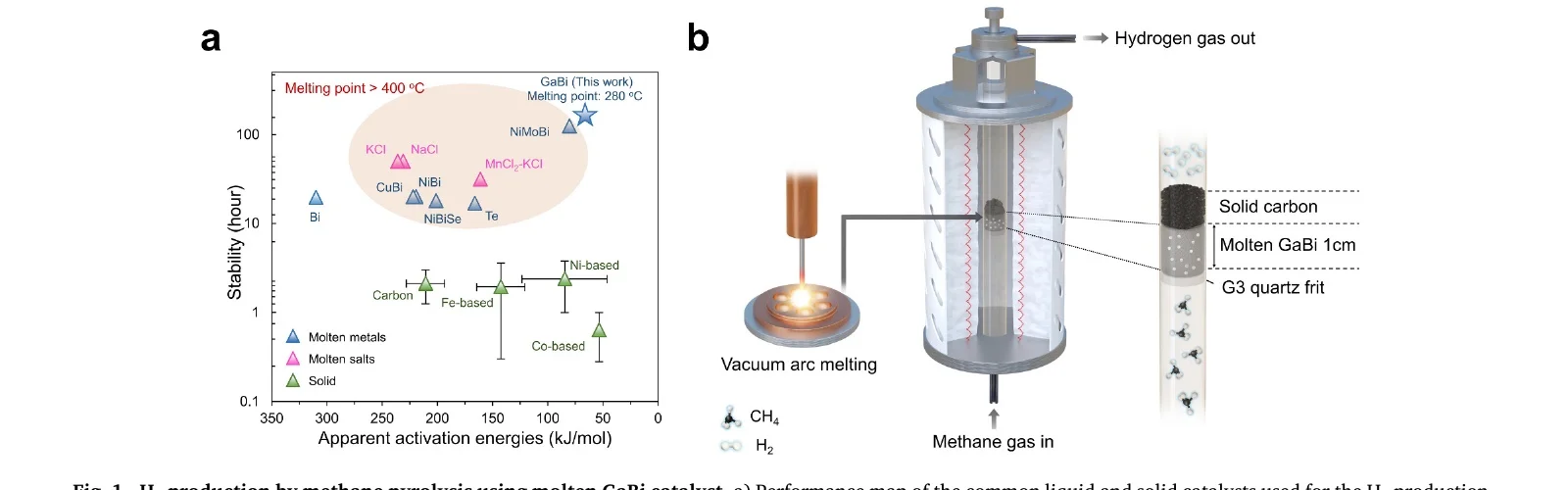
Methane pyrolysis is a promising route to CO2-free H2 production, but conventional solid catalysts deactivate as solid carbon deposits on their surfaces, and most molten metal catalysts require operating temperatures above 900 °C. The study presents a molten gallium–bismuth (GaBi) catalyst that is effective for methane pyrolysis at moderate temperatures of 500–800 °C. The Ga0.11Bi0.89 alloy showed the lowest activation energy (67.2 kJ/mol) among reported molten catalysts and maintained stable hydrogen production for 158 h at 800 °C. Ab initio molecular dynamics (AIMD) calculations revealed that the exceptional performance originates from suppressed Ga–Ga aggregation and enhanced Ga mobility in the melt.
A techno-economic analysis and life cycle assessment of a simulated 552 ton H2/day plant projected an 80.7% reduction in total installed cost and a 79.1% decrease in operating cost relative to water electrolysis, along with a net-negative environmental footprint.
Our group led the electron microscopy characterization at the core of the study’s structural conclusions. A key challenge was preserving the native state of Ga — which melts at only ~30 °C — throughout the analysis. From cross-sectional SEM of the alloy recovered after 158 h of operation, we found no distinct alloy phase between the Ga and Bi domains, supporting the GaBi melt as a single homogeneous liquid. By transmission electron microscopy (TEM) of the solid carbon byproduct, HRTEM and FFT analysis revealed a graphitic structure with ~5 nm domains and an expanded (002) interlayer spacing of 3.56 Å (~6.3% larger than ideal graphite). These analyses directly supported the conclusions on catalyst reusability and on the quality of the produced carbon.
Read the full paper here.