

Multi-scale EM analyses for breakthroughs in materials science
We combine high-resolution imaging, data-driven analysis, and correlative microscopy to reveal how materials truly work.
About Our Lab
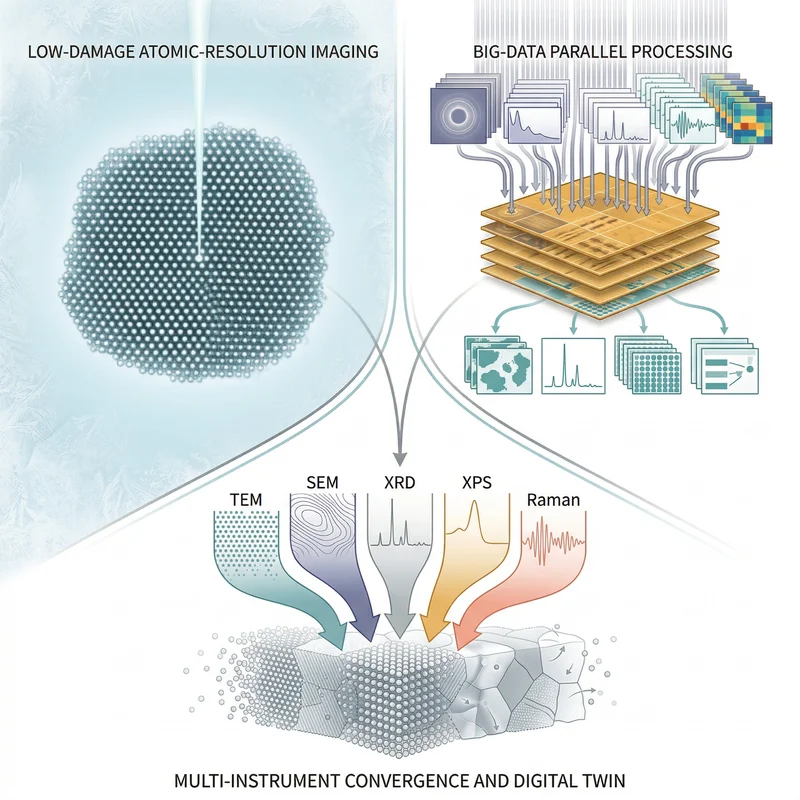
Material performance is determined by subtle differences at the atomic and interfacial level. Yet conventional analysis has often been limited to interpreting fragmented data from individual instruments — like guessing a full picture from a single puzzle piece.
AEML tackles this challenge through three pillars: low-damage, high-resolution observation, data-driven analysis, and correlative analysis. These form a unified analytical workflow — precisely observe, statistically interpret, and comprehensively connect. Through low-damage, high-resolution observation, we minimize specimen alteration while probing the finest features. Through data-driven analysis, we leverage in situ/operando techniques and parallel processing of large-scale EM datasets to quantify structural and chemical trends. Through correlative analysis, we integrate results from TEM, FIB, SEM, XRD, XPS, Raman, and more at the same sample location, achieving seamless multi-scale characterization.
This analytical strategy extends beyond energy materials such as batteries and catalysts to semiconductors, ceramics, and bio-materials. Grounded in a fundamental understanding of analytical techniques, AEML actively embraces AI/ML-based data analysis methodologies and applies them to diverse materials challenges, expanding the frontiers of characterization. In doing so, we aim to guide the design of next-generation materials while nurturing convergent researchers who bridge electron microscopy operation and data interpretation, contributing to the future of materials science.
Selected research
Revealing crack-healing mechanism of NCM composite cathode for sustainable cyclability of sulfide-based solid-state batteries
Kyu-Joon Lee†, Young-Woon Byeon†, Hyun-Jeong Lee†, ...
Electronic structure manipulation via composition tuning for the development of highly conductive and acid-stable oxides
Young-Woon Byeon, Jonathan P Mailoa, Mordechai Kornbluth, ...
High-entropy mechanism to boost ionic conductivity
Yan Zeng, Bin Ouyang, Jue Liu, ...